
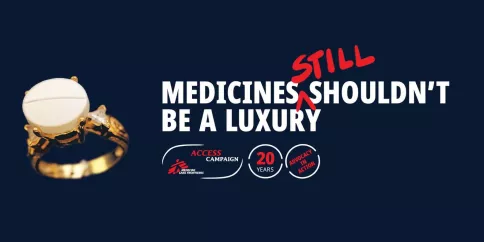
Over 110,000 emails sent to the drug companies six weeks after our launch. We’re spreading more widely now – the latest boost online came from people signing up in Brazil and we also have a ream of handwritten signatures from South Africa, being sent over from the MSF projects in Khayelitsha just outside Cape Town.
We’ve got the video and photos through from the Swiss launch of the campaign on the banks of Lake Geneva (Leman if you are French..) – it got a huge amount of local media attention and now there are plans for the Big Pill to be dropped in waters elsewhere too.
It’s a sign we’re making progress at the highest levels that UNAIDS, the United Nations’ joint programme on HIV/AIDS, also decided recently to bring together patient groups, NGOs, pharmaceutical companies and European Commission representatives in Brussels to explore the patent pool initiative. And it was clear from these talks that we’ve moved on from discussing IF the patent pool is a solution and now the question is how to make it work.
UNITAID is scheduled to green light the project mid December so we really need to keep up the pressure on the companies – please make sure you share the campaign as widely as possible within your own networks.
Quote of the Week
“We start to see young women now to whom we said ‘those tablets will save your life,’ and now they have become resistant to their second-line drugs. And we are obliged to tell them ‘there is no further option for you’. I think as a clinician this is absolutely unacceptable. The commitment was to accompany them as long as we could and as long as they were alive. And to say to a patient who’s still very well, ‘sorry but we have no options,’ is not acceptable”
Dr Eric Goemaere is medical coordinator at the Khayelitsha project outside Cape Town in South Africa that treats many people living with HIV. He voices the anger felt by medical staff that newer antiretroviral drugs are just not available for patients. The patent pool could offer a solution.
The Myth Busters
Drug companies say they are already doing a lot for access and innovation through such company-led schemes as donations, price discounts, tiered pricing and granting ‘voluntary licenses’. Do they have a point?
None of these INITIATIVES have provided an efficient and sustainable solution to the problems of access to medicines: prices remain high on existing medicines nor do these initiatives promote the kind of innovation that we need in terms of speeding up the development of child-friendly medicines and production of new fixed dose combination therapy.
Here’s why:
Tiered pricing can result in high prices being charged in middle-income countries where there is an emerging middle class that lives alongside millions still in poverty who can’t afford the high price of medicines.
Companies say they offer generous discounts, but these are not deep enough and do not match the prices that can be obtained from generic competition. It was only when drug prices came down by 99% as a result of competition from generic companies that first line AIDS treatment became affordable to most countries. In addition they often don’t bother to register drugs in the countries listed, as registration is a long and cumbersome process and they don’t expect to make a profit in these countries. So the drugs just aren’t available, regardless of the price. Simply cutting prices not only fails to achieve the costs savings from generic competition, it also does nothing to remove the patent barriers which prevent the innovation we need.
Voluntary licences issued by individual companies can contain restrictive terms. For example an originator company can maintain control over which countries are able to benefit from lower prices, laying down where the drug can be imported and can exclude certain countries. There can be other restrictive conditions too for instance in one case a company also stipulated that the licensee had to buy the active pharmaceutical ingredient from the originator company, which fixed cost made price reductions less achievable.
In any case, these piecemeal initiatives, dependent on one company, cannot give us a collective sustainable solution to a global problem.